Showing posts with label Oasis. Show all posts

Tuesday, 29 November 2011

Suede : A Musical Obsession.

If you have ever found yourself under the mesmerising spell of an artist or band; caught in a limbo world where no other music but that of said musicians is of any interest to you, where you can think of no better way to spend your time than pouring through as many interviews and trivia bites as you can feast your eyes on, flicking through youtube videos and absorbing all such information with as much ease as a newly purchased sponge, then I look to you for understanding and empathy; as this is exactly how I feel about Suede right now.

It hits you almost like a fever; unexpected and unexplainable in its approach, you just wake up one day and find that it has wrapped its merciless fingers around your whole body, and there is little you can do but ride the wave to its natural conclusion. As an obsessive with an obsession for music, this is a pattern that I have dealt with on several occasions before, however there is no telling for how long I will be inflicted with a disease which has seen my requirements for oxygen usurped by the need to hear Dog Man Star on indefinite repeat.

Anyone who has ridden the musical fixation rollercoaster can tell you that, despite its ability to overrule all rational thought, and overspill into various aspects of your life – it is not an unpleasant experience; in fact it is an absolutely fantastic feeling, of which every second is rich with appreciation. Music never sounds as good as when you are in the throes of irrational obsession, and you can wave goodbye to any difficult decisions regarding what to listen to on your ipod, or indeed; what to write about on your blog.

Perhaps at this point I should address the band over which I am so shamelessly gushing, and in doing so, acknowledge how unlikely and random a candidate they really are, however I struggle to know where to begin with Suede. Victims of a bizarre and unjust turn of events, whereby they were seemingly ousted from the Britpop movement for not complying to the laddish, boozing, fake-working-class checklist, despite the fact that they themselves kick-started the subgenre, but in turn expressed no desire to be associated with what it went on to embody. The hype surrounding Suede’s emergence in 1992 was truly extensive, with Melody Maker proudly adorning their front cover with the words “Suede: the best new band in Britain” and the following year, the Brit Awards shuffled around their schedule in order to afford them a last-minute slot at the ceremony as a direct response to pressures from the music press – all before an album had even been released. With so much hype surrounding them, it would have been easy to disappoint or fall victim to overzealous critics, however their first self-titled album was an enormous critical and commercial success subsequently earning them a Mercury Music Prize in 1993, and then leading on to record – what I believe to be their true masterpiece – Dog Man Star in 1994. Despite a string of increasingly commercially successful albums throughout the 1990s before disbanding in 2003, Suede are rarely remembered and seldom played in 2011. This is a great shame, as they are truly brilliant and arguably the best and most interesting band of the 1990s – an achievement for which I hold their astoundingly fascinating frontman mainly accountable.

One look at Brett Anderson’s erotically charged, androgynous stage persona will quickly answer questions regarding why they didn’t fit in well with the overtly laddish overtones of peers such as Liam Gallagher and Damon Alburn. Incredibly charismatic and instantly fascinating, Anderson can be seen strutting the stage with a stereotypical feminine haircut, big silver hoops through his ears and a black lace top tied loosely around his slim and hairless torso, singing lines such as 'I want the style of a woman, the kiss of a man'; he certainly cuts a striking and controversial image. However, this is most effective due to the way in which Anderson conducts his androgyny; with such self-assurance and masculine gusto, proudly stalking the stage in the knowledge that he is twice the man that any jean-wearing guy swigging beer at a football match could ever be. It is no wonder that he managed to ruffle a few feathers in a time where shell-suits reigned supreme, and American grunge was topping the charts. While Suede’s absence from the common consciousness of today is a shame in part, I am not sorry that their songs haven’t received The Universal or Wonderwall treatment, and that their music can be enjoyed without being tarnished by advertising campaigns or being strummed by incompetent guitar players in parks and festivals across the country.


I would recommend the album Dog Man Star to anyone, as it really is a five-star album that can be enjoyed perfectly from start to finish. While Suede may not have been flying the flag for British optimism, Anderson’s observations of suburbia are accurate and representative of a generation who came of age during the perilous 1980s, delivered via his impressive and instantly recognisable vocals. Introducing The Band, New Generation and Black or Blue are particularly good at summing up the feelings of British disillusionment that Britpop was soon to gloss over with the resounding opening chords of Blur’s Parklife.

So I will continue to ride out my obsession with all things Suede and Brett Anderson, even to the extent of finding myself shaving the hair on the right side of my head in an attempt to adopt some of the latter into some visual aspects of my life, as well as having him provide the audio soundtrack to my every move. Their performance of Animal Nitrate at the Brit Awards in 1993 is one that I keep going back to, and something that I suggest you check out if you are at all interested in what it is that has sparked such infatuation with the band and their music. I have included it below, but be warned; musical obsession is contagious. 


Sunday, 16 October 2011

Unemployment : A Few Words From The Wise.

Call up the craftsmen
Bring me the draughtsmen
Build me a path from cradle to grave
And I'll give my consent
To any government
That does not deny a man a living wage – Billy Bragg

Having spent the past few months unemployed and subsequently going through a myriad of emotions on the subject; first thinking that I would only take a job that I wanted and suited my own interests, followed by a rapid descent into the depths of ‘I will take any job going’ territory, facilitated by crawling around various agencies and applying for call centres, I then rediscovered my soul (with a little help from the misguided benefit system) and proudly proclaimed: “why should I take a job that I don’t want to do?” Especially when in many cases, you would be worse off if you took a job…and you’d have forty hours less a week in which to do things that you actually want to do. Madness surely, and a fair reflection of the state of society that we live in today. Instead, I’ve reached the conclusion that until I find a job which takes me in exactly the direction I want to be heading in, I will be much better off using this time to fulfill creative ambitions, volunteering and acquiring experience which will ultimately lead me to my career of choice. I opt for this instead of spending my days assisting, and therefore condoning, a pointless system of administration upon which we are all unfortunately forced to rely, by taking any stupid office administration job pushed in my direction.

In times of trouble or unease, music usually has a way of coming through for me - reaffirming my beliefs and assuring me gently that millions of people have felt this way at some point…hell, they’ve even screamed it at the top of their lungs in stadiums. While I can see a fair point in the argument that musicians ‘use’ the working-man’s gripes in their music in order to maintain a grasp on their fan base’s reality – while in the meantime they are chauffeured around in Rolls Royce’s and drinking only the finest champagne in penthouse suites - there is no element of fakery involved when singing along to The Smiths ‘Heaven Knows I’m Miserable Now’ on a grey November morning on your way to the office. As such, I have acquired a list of songs which I think sum up a great deal on the subject, and have discussed them in short below;


Oasis – Cigarettes and Alcohol
Is it worth the aggravation 
To find yourself a job when there's nothing worth working for?
 
It's a crazy situation
 
But all I need are cigarettes and alcohol

This song highlights the appeal and subsequent dependency on cigarettes, alcohol and drugs as a remedy to the futile nature of working class life. While many people could not be blamed for finding vices in such things, it is particularly insulting when we witness constant rises on alcohol and tobacco taxes as the government steadily ensures that the working man can no longer afford the few items that get him through the mundane activities of day-to-day life. Tapping into the common sentiment of western disenchantment, it’s no wonder that it has re-appeared several times in the charts since its first release in 1994.


The Smiths – Heaven Knows I’m Miserable Now

I was looking for a job, and then I found a job 
And heaven knows I'm miserable now
 
In my life
 
Why do I give valuable time
 
To people who don't care if I live or die?


Taken from the 1984 compilation album ‘Hatful of Hollow’, this is perhaps the most explicitly simple statement of how I feel right at this moment. Why are we forced to donate the most valuable asset that we have - our time – to a faceless corporation or activity in which we hold no belief and derive no pleasure? What The Smiths have done so brilliantly here is demonstrate how we find ourselves in such a position without real choice or thought, as this is the path we are all forced to go down whether we like it or not.


John Lennon – Working Class Hero
When they've tortured and scared you for twenty odd years, 
Then they expect you to pick a career,
 
When you can't really function you're so full of fear,
 
A working class hero is something to be,
 
A working class hero is something to be.


Keep you doped with religion and sex and TV,
 
And you think you're so clever and classless and free,
 
But you're still fucking peasants as far as I can see,
 
A working class hero is something to be,
 
A working class hero is something to be.
 

This song is a take on the class split of the 1940s and 1950s, and of the 1960s in which John Lennon was famous. The song appears to tell the story of someone growing up in the working class. According to Lennon in an interview with Rolling Stone magazine in December 1970, it is about working class individuals being processed into the middle classes, into the machine. Another demonstration of the inevitability that many people face thanks to the systems in place to keep the working class unquestioning of their fate, this song faced much controversy upon its release – most probably for fear of raising awareness of exactly such issues.
 (Exerts from : en.wikipedia.org/wiki/Working_Class_Hero)


Pink Floyd - Money
Money, get away
Get a good job with more pay and you're okay
Money, it's a gas


Money, it's a crime
Share it fairly but don't take a slice of my pie
Money so they say
Is the root of all evil today
But if you ask for a raise it's no surprise that they're giving none away

Focusing more on the financial side of things, ‘Money’ from Pink Floyd’s ‘Dark Side of the Moon’ brilliantly illustrates why millions of people find themselves heading off to jobs they hate every morning of the week – because we are repeatedly being told, from an increasingly young age, that everything is all about money. That is apparently enough justification to hate our lives, to waste our precious time, to start wars and to repeatedly screw over our fellow human beings. Money, it’s a gas.


Bob Dylan – Maggie’s Farm
I ain't gonna work on Maggie's farm no more
No, I aint gonna work on Maggie's farm no more
Well, I wake up in the morning
Fold my hands and pray for rain
I got a head full of ideas
That are drivin' me insane
It's a shame the way she makes me scrub the floor
I ain't gonna work on Maggie's farm no more

Well, he hands you a nickel
He hands you a dime
He asks you with a grin if you're havin' a good time
Then he fines you every time you slam the door

Within ‘Maggie’s Farm’, we see Dylan singing for the youth of his time, urging them to reject society and question what is happening around them, as opposed to quietly accepting an unfair fate and as a result; pushing any ideas and hopes that you had to one side.  The "farm" that Dylan sings of could easily represent racism, state oppression and capitalist exploitation, and has subsequently been used and covered on numerous occasions since its release in 1965 as a symbol of protest.


The Beatles – Taxman
Let me tell you how it will be; 
There's one for you, nineteen for me.
 
'Cause I’m the taxman,
 
Yeah, I’m the taxman.
 

Should five per cent appear too small,
 
Be thankful I don't take it all.
 
'Cause I’m the taxman,
 
Yeah, I’m the taxman.
 
Now my advice for those who die, (taxman) 
Declare the pennies on your eyes. (taxman)
 
'Cause I’m the taxman,
 
Yeah, I’m the taxman.
 

And you're working for no one but me.
 

Taxman!
 

‘Taxman’ is a song written by George Harrison released as the opening track on The Beatles 1966 album ‘Revolver. Its lyrics attack the high levels of progressive tax taken by the British Labour government of Harold Wilson. Harrison said, “‘Taxman' was when I first realised that even though we had started earning money, we were actually giving most of it away in taxes. It was and still is typical." The Beatles' large earnings placed them in the top tax bracket in the United Kingdom, liable to a 95% supertax introduced by Harold Wilson's Labour government, so while they were wealthier than most, they certainly knew a thing or two about the unfairness of the tax system.
(Exerts from : en.wikipedia.org/wiki/Taxman)


The Enemy – Away From Here
I'm so sick sick sick and tired
Of working just to be retired
I don't want to get that far
I don't want your company car
Promotions ain't my thing
Name badges are not interesting


Reverend and The Makers – Heavyweight Champion of the World
It might be boring so boring
It might put you to sleep
The same old routine repeats week after week
And you work harder, work harder
Cos you’re told that you must
And you must earn a living
And you must earn a crust…like everybody else
Just be like everybody else


Here, with these songs by The Enemy and Reverend and The Makers, we find two more recent examples of how disillusionment with the working system is still as prevalent as ever. In these cases, the most apparent themes seems to be of boredom with the repetitive routines, and fighting out against what is expected of us, despite whether this bares any relevance to what we actually want to get out of our lives – lives which we only have the pleasure of living once. For as long as society keeps such outrageous systems and restrictions in place, more songs on the subject will continue to be written, and we can continue to enjoy them in the understanding that there is hope and a shared desire for a time when this will no longer be the case.


Right, back to the jobhunt…

Sunday, 2 October 2011

On The Back.

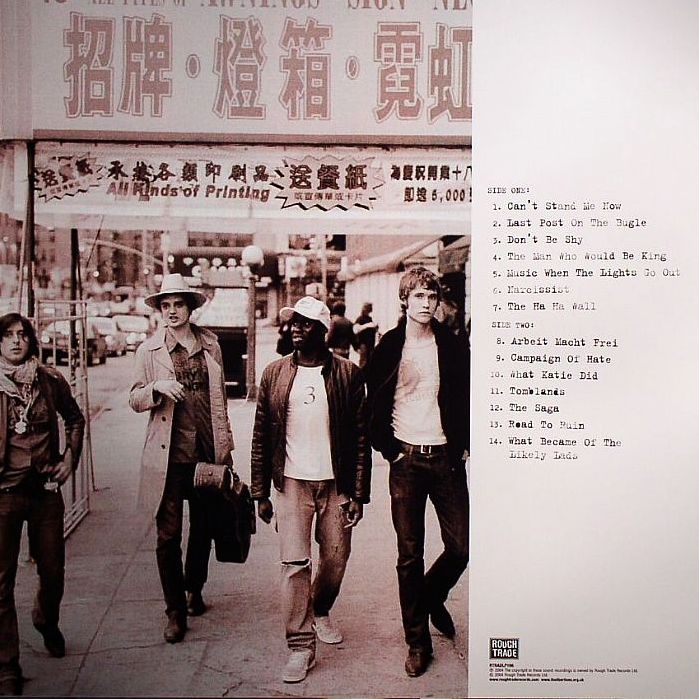
Following on from my previous post in which I discussed the loss of album artwork in the digital age - a time when all album covers are reduced to a thumbnail image and the back covers and sleevenotes are rendered obsolete - here are some brilliant back covers which will be a particularly sad loss to the mp3 audience :


The Libertines - The Libertines

David Bowie - Ziggy Stardust and The Spiders From Mars

Guns N' Roses - Appetite For Destruction

The Eagles - Hotel California

John Lennon - Double Fantasy

Oasis - Definitely Maybe

The Specials - The Specials

David Bowie - Space Oddity

My Zimbio